
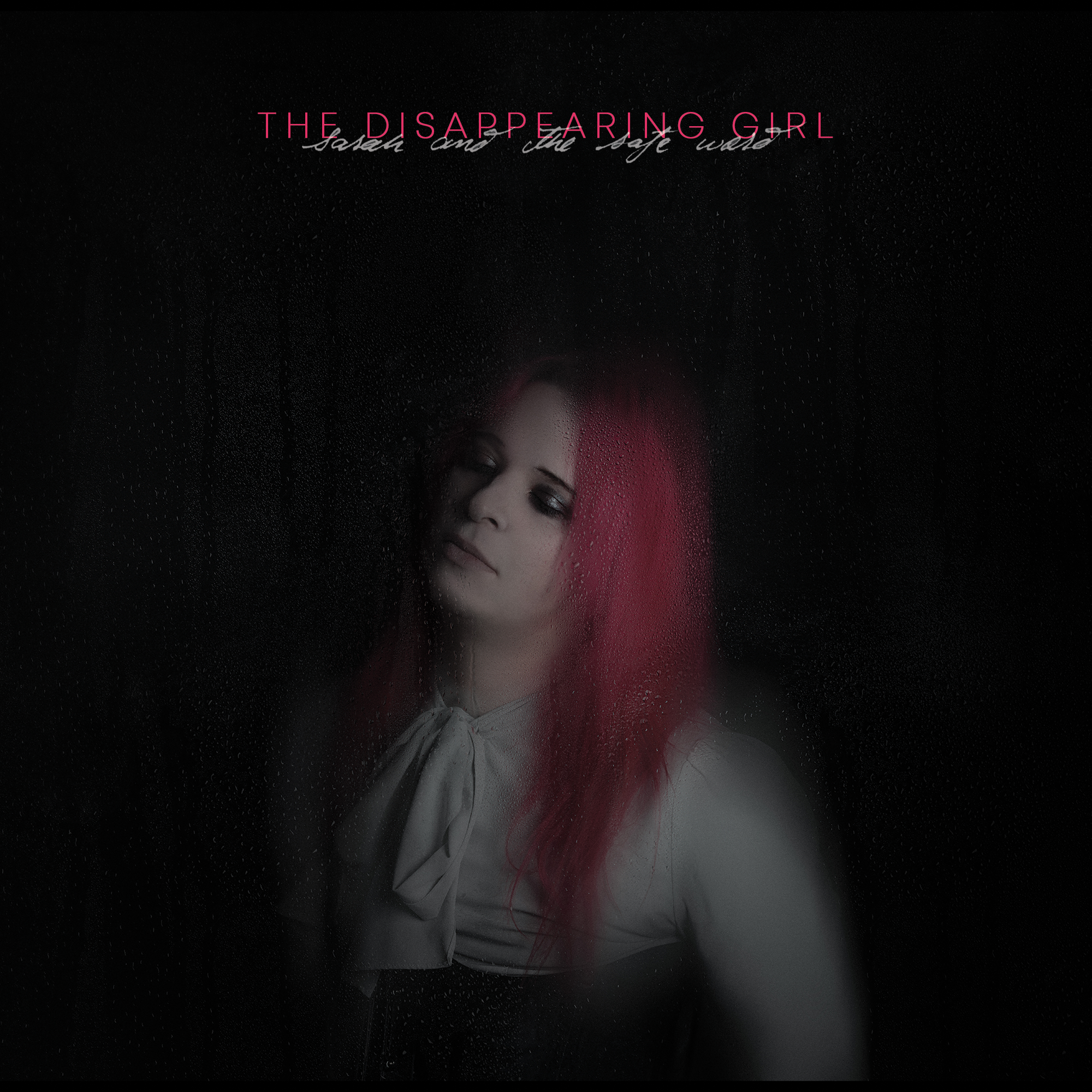
On Friday, August 7th, Georgia-based rock/dark cabaret band Sarah and the Safe Word will release their latest album, The Disappearing Girl. A journey through introspective self-discovery, hedonistic expression, and the sinfully decadent caress of one’s listening ear, TDG is a massively delightful romp to who-knows-where. And, as the title suggests, we got an early chance to review this album! Here’s what we think about Sarah and the Safe Word’s latest album. A big thank-you to Sarah Rose for providing early access to the tracks!
Track-by-Track Review of The Disappearing Girl
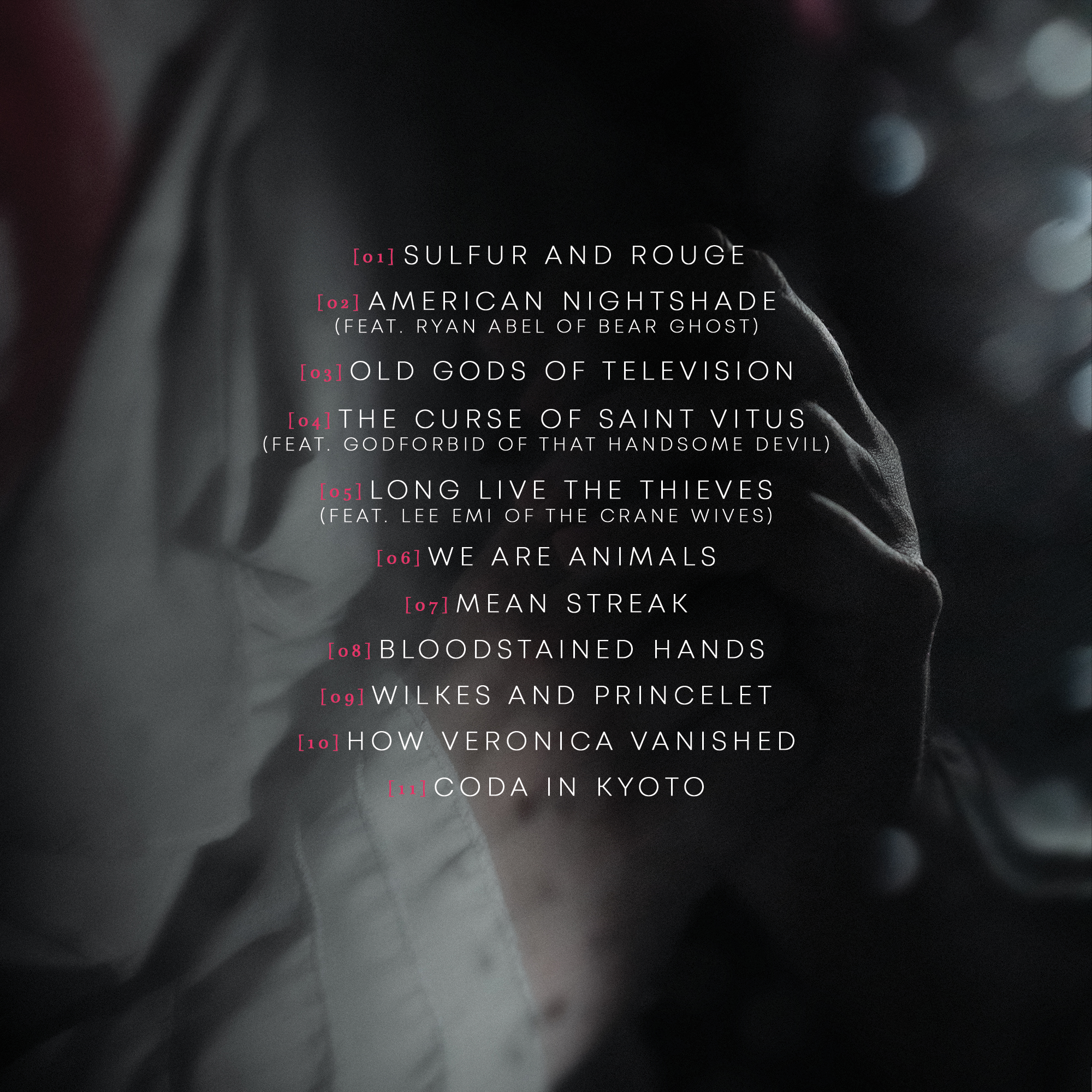
As I typically do where albums are concerned, I take the span of the song I’m reviewing to write my opinion of the track. So, let’s start with “Sulfur & Rouge”, the first track off The Disappearing Girl:
“Sulfur & Rouge”
This first track gives the vibes of a dark, smoky lounge, wherein our singer sets the stage for a much darker tale. There is a mystery at work here, already well underway, and it’s our job to piece it together. Or not. But it’s more fun to try, isn’t it?
“Sulfur & Rouge” does an excellent job of creating the setting we are craving from most any SatSW album, while still creating something remarkably distinct from that. While the track is undeniably new, it also is distinctly Sarah. And at the end of the day, better the devil you know…
“American Nightshade” (feat. Ryan Abel of Bear Ghost)
The next track, “American Nightshade”, features Bear Ghost‘s own Ryan Abel, in a wonderful, devilish collaboration that is as expected in its personage as it is refreshing. The track begins with the type of twist on the head of “Sulfur & Rouge” that Sarah’s fanbase will, and no doubt already have, gone gaga over (as, for those not already in the know, “American Nightshade” is one of the singles off of The Disappearing Girl). The track continues, wild and rambunctious, through Ryan Abel’s awesome featured verses and the rest of the track. What an absolute gift that Sarah and the Safe Word has granted us!
“Old Gods of Television”
Track three off of The Disappearing Girl is “Old Gods of Television”, a bold, bawdy take on the new ways that media have effectively overthrown worship. Another absolute banger from this album, “Old Gods” is a treat. It’s even louder and boisterous than “American Nightshade”, and I’m all for that. What more can I say about this track than I adore it?
“The Curse of Saint Vitus” (feat. God Forbid of That Handsome Devil)
Saint Vitus was a Christian martyr from Sicily who lived during the early 4th Century AD. Knowing this, you just know that Sarah was going to do something wicked with this track in fresh defiance. Adding in God Forbid of That Handsome Devil was a great way to achieve this. The aforementioned Vitus was also associated with a “dance” which was actually a syndrome that caused jerky, involuntary movements in its afflicted. The lyrics allude to something similar in a twisted sort of way. Kind of awesome, really!
“Long Live the Thieves” (feat. Lee Emi of The Crane Wives)
Track five, “Long Live the Thieves”, is another song that features an outside talent. In this case, Sarah has enlisted Lee Emi of The Crane Wives to assist in singing a lower-tempo song that tickles my eardrums in at least a few ways that all work nicely. This song is a nice, well-timed reprieve from the up-tempo raucousness that precedes it. At the same time, “Long Live the Thieves” doesn’t allow the band to let go of the main conceit of this album thus far. This song can be seen as a beautifully kleptocratic political statement, in theory, and that just delights me.
“We Are Animals”
“We Are Animals” is the sixth track of the eleven on The Disappearing Girl. This track begins darkly, almost like an “Imperial March”-type of scoring to begin with. It’s clear that this track was meant to be a few belts heavier than the songs that came before it, but no less powerful or profound. The string-instrumentalism that pervades across the track is probably my favorite part of it, but I suppose that’s why I’ve been tasked with reviewing this album altogether! In all seriousness, though, this is a strong track that I could imagine being performed in the kind of dystopian future that, let’s face it, we are currently subsisting in.
“Mean Streak”
“Mean Streak” was another of the singles from this album. It’s also a return to the same kind of raunchiness that I have described previously. I mean that as a total compliment to the band; it’s glorious. I completely understand why this was one of the singles. The strings backing the verse following the first chorus are positively infectious. Be they banjo or mandolin, I’m a firm fan of this instrumentalism. The lyrics are also seriously cool. You ought to listen for yourself!
“Bloodstained Hands”
“Bloodstained Hands” is a strong track, but it kind of suffers from being right after a song like “Mean Streak” and preceding “Wilkes & Princelet”, a track that, quite frankly, is my favorite on the album. There’s nothing wrong with the track, per se, but location in ephemera makes this song feel a little weaker than the two that it’s sandwiched between.
“Wilkes & Princelet”
Let me be frank: I effing love this track. “Wilkes & Princelet” scratches an itch in my mind that I’m so thankful is being addressed here. My only complaint with the track is that it’s literally the second-shortest one on TDG. It feels like it’s continuing the story that Sarah Rose and the rest of the Safe Word is more privy to than most. Hmm… I wonder if SatSW will ever pursue a graphic novel series, à la Coheed and Cambria. But I digress. This is a great track, and I have no notes beyond the pains of brevity.
“How Veronica Vanished”
“How Veronica Vanished” is the tenth track on this album, and it’s a shame that we are getting this close to the end of it because it’s been a wonderful journey so far. Anyhow, this track is heavy in a good way. It feels as though it is conveying a heartfelt, though perhaps apathetic, goodbye. These kinds of tracks on Sarah and the Safe Word’s albums always seem to be the climactic culmination of the narrative beats the band is producing. I’m always all for it.
“Coda in Kyoto”
The final track off The Disappearing Girl, “Coda in Kyoto” seems to me like it’s a necessary end-credit song. Is this song part of the narrative of Veronica and her departure from present company? Is it furthering the story? Does that truly matter? The song is entertaining, and that absolutely is most often the point of the roles of true entertainers such as Sarah Rose and her merry band. There’s also a verse where the instruments are muted except for the lead guitar, and that really spoke to me aurally. Very cool, to be frank.
My Verdict
The Disappearing Girl is a fantastic album to listen to. I listened to it repeatedly and in succession, during a brief trip downstate from Rochester, NY, to New York City, as well as on the way back up. I felt a certain profundity to this, because I briefly disappeared from my home during this trip, only to wind up in the place I left a good eight years prior. However, listening to it on the Amtrak back up felt more akin to the kind of anomaly that Sarah and the Safe Word, I believe, were trying to convey. I don’t know the next time I’ll be back down there, and, to be fully honest with myself, that’s pretty darned okay by me.
In any event, I really would implore you, dear readers, to give The Disappearing Girl a good multiple listens. It’s that good.